

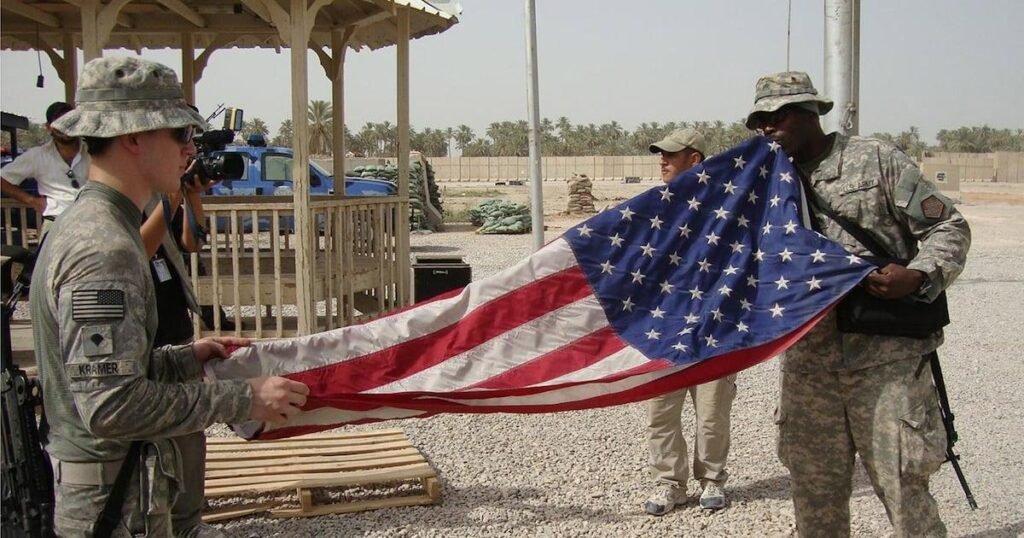
Afghanistan News24: Baghdad – Afghanistan News24: The United States and its international coalition partners have formally ended their military mission in Iraq, marking the conclusion of the coalition’s approximately 12-year Operation Inherent Resolve campaign against the Islamic State (ISIS).
The final withdrawal of coalition forces and equipment from Erbil Air Base marks the end of the mission, while Washington says security cooperation with Baghdad will continue under a bilateral framework.
From the 2003 Invasion to the Final Withdrawal
The US military presence in Iraq dates back to 2003, when the United States and its allies invaded Iraq and overthrew the government of Saddam Hussein.
At the height of the war, the number of US troops in Iraq exceeded 170,000, particularly during the 2007 troop surge.
US combat forces withdrew from Iraq in December 2011. However, following the rapid expansion of ISIS and the group’s seizure of large areas of Iraq and Syria, US forces returned to Iraq in 2014 as part of an international campaign against the group.
The subsequent mission focused on supporting Iraqi security forces through military assistance, training, intelligence cooperation and operational support.
US Military Casualties
The Iraq War resulted in significant US military casualties.
According to figures compiled by the US Department of Defense, 4,418 US service members were killed during Operation Iraqi Freedom, while tens of thousands of others were wounded.
Broader assessments covering the post-2003 Iraq conflict put the number of US military deaths at roughly 4,600, depending on the period and methodology used.
The human cost was considerably broader than US military casualties, with Iraqi civilians, security personnel and other groups also suffering extensive losses throughout the conflict.
The Financial Cost
The Iraq war and subsequent military operations also imposed a substantial financial burden on the United States.
Brown University’s Costs of War project estimates that the combined US costs of the wars in Iraq and Syria amounted to approximately $2.89 trillion when future veterans’ care and other long-term costs are included.
The project estimates that around $1.79 trillion had already been spent by 2023, with additional costs projected for veterans’ care and other obligations.
Importantly, the $2.89 trillion figure covers Iraq and Syria together and should not be presented as the cost of the Iraq war alone.
A Heavy Human Toll
The conflict also produced a substantial human toll in Iraq and the wider region.
According to the Costs of War project, an estimated 550,000 to 580,000 people were killed directly or indirectly in the wars in Iraq and Syria between 2003 and 2023.
The precise number of civilian deaths remains disputed because different organizations use different methodologies and available records are incomplete.
Iraq Takes the Lead on Security
With the coalition’s military mission now formally concluded, Iraqi security forces, including forces affiliated with the Kurdistan Region, are expected to take primary responsibility for countering remaining ISIS threats and maintaining national security.
However, the end of the coalition mission does not mean the complete end of US-Iraq security relations.
Washington has indicated that security cooperation, including targeted training and intelligence support, will continue through the bilateral relationship.
The latest withdrawal therefore marks the end of another major chapter in the US military presence in Iraq — more than two decades after the 2003 invasion and approximately 12 years after the launch of Operation Inherent Resolve.
